
Pink Moon
Featured in ‘Sunlight Later’
If the clouds are accommodating
then tonight’s full “pink moon” will be a little bit bigger in the sky
as our planet’s only satellite is almost as close to us as its orbit allows.
But beware the misconceptions about the names people give to moons:
“The pink moon is named not because it will take on a particular colour
But because of the colour of the flowering phlox, coming into flower”
say the astrophysicists. So no, the moon definitely won’t be pink
“unless there is pollution in the air and it could take on a reddish tinge”
and anyway, will it be worth the early start? The moon is the same moon
wherever you are, but do I want it to superimpose its spurious pinkness
here, onto my memory of the last time I saw it so big, there
back when my hands were small and worries were smaller
eye pressed tight to Dad’s big red telescope angled towards home
skies and familiar constellations, me in my pink pyjamas and
the too-big communal coat that smelled of bonfires and apples
just turned, the other eye squeezed shut to let the moonlight
flood the finder, it’s dark orange light light leaking through
the lens to mine, craters too real to be real, shadows bleeding
to dark, our planet’s only satellite open-mouthed in sorrow’s song.
And I wondered if it was really sad, or maybe just thinking,
if it was really alone, or maybe just waiting.
An extra note
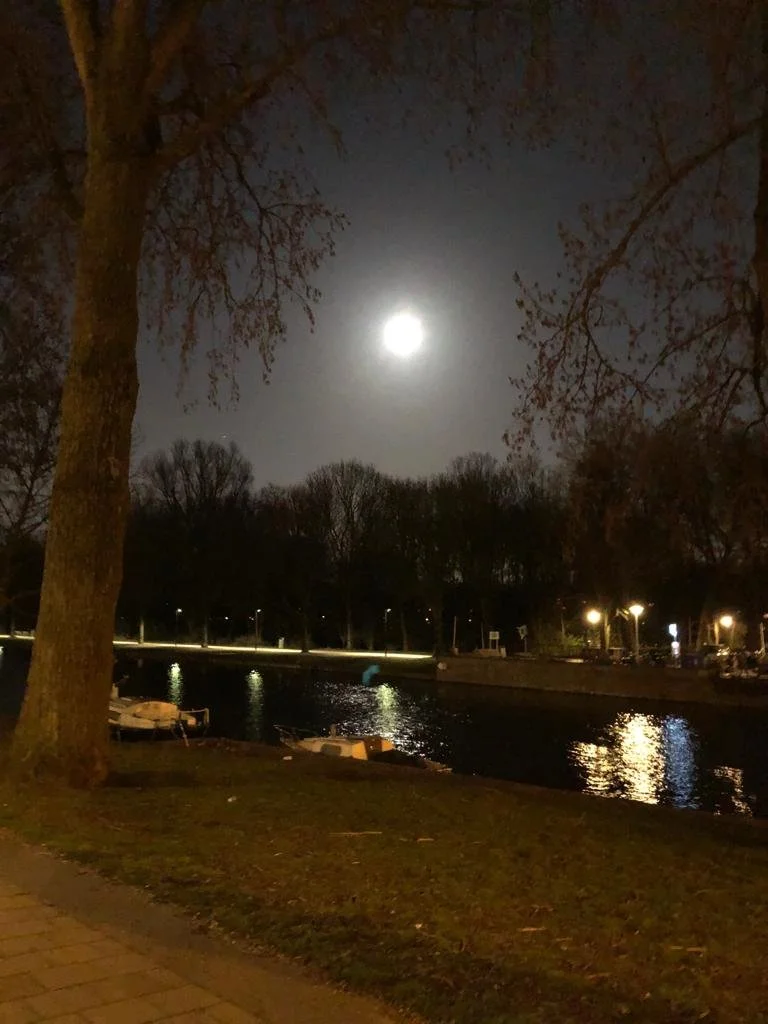
Sometimes, something seemingly so matter of fact can trigger memories or emotions that you weren’t even aware were there. This poem is about homesickness - about a longing for familiarity, for family, and for the past. The first half of the poem uses scientific, factual language to describe the phenomenon of a ‘pink moon’. And the second half, after the line ‘but do I want it to superimpose its spurious pinkness / here, onto my memory of the last time I saw it so big, there’ becomes the gateway into the emotional memory. Here we meet a narrator longing for her ‘home skies’, reminiscing about the innocence of childhood, and missing her dad - all through the ‘lens’ of looking at the moon.